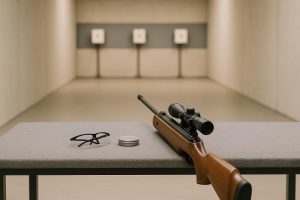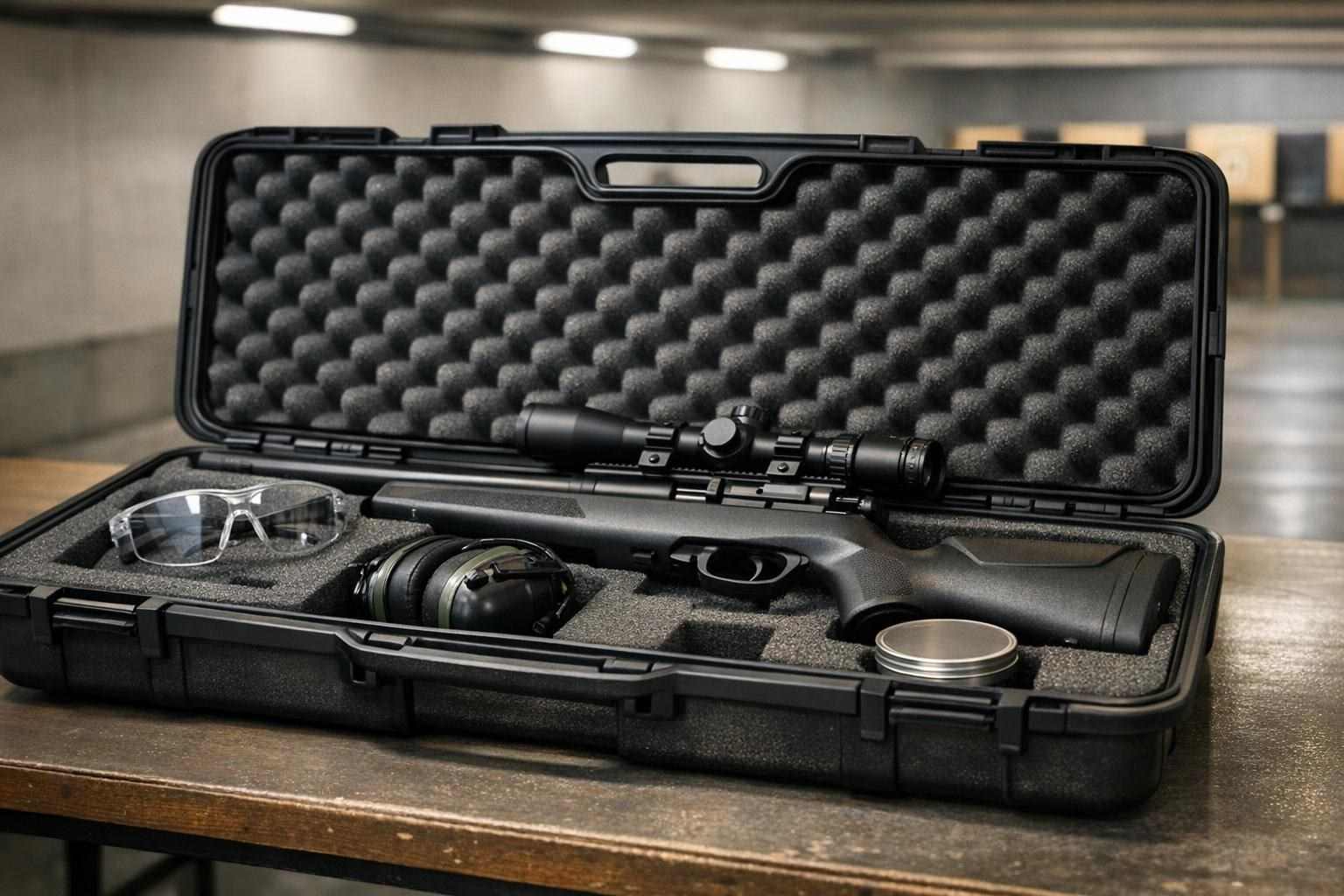
You don't want your precious airgun and accessories to get damaged on the way to your indoor range, so it's good to take them in a case. This also means that all small parts and accessories will be kept together, so you won't have to search for them just before leaving for your shooting session. Also, your case should not be too big, so you can easily carry it and store it in your club room. So, the best way to pack your airgun and accessories for your trips to the shooting range is by means of a fixed checklist. This checklist will outline what you need to take with you, what you should leave behind, and what you should check with the club or at the authorities' websites.
Start with the equipment you actually use
Pick a case to match the gun and the items you already normally take. A case that is too small for normal use can press upon gears, under-leverages, triggers, sight adjustment etc. A case that is too big will no doubt allow things to move inside it and become a much larger and more impractical item for carriage around, in cars, up/down stairs, around corners etc.
If your equipment needs to travel within a set of dimensions, then measure the main parts of your equipment (minus any attached items) and then add sufficient padding to the interior of your case, plus any permanent fixtures. Ensure that your airgun sits centrally and is not forced into the case, and that it does not move about when the case is picked up and gently moved about.
In addition to offering protection against impact, a hard-sided case also offers protection against undue pressure. Soft cases often are less heavy and easier to stow, but they require extra care when moving them to hard surfaces or in tight transport situations. Don't assume that a soft case is better than a hard-sided case for all uses. Likewise, do not assume that a hard-sided case is the best option for all uses. Choose the case that best fits your use, and ensure that it can be carried, that it will be stored, and that it will be viewed as appropriate by the club.
Build a clean interior layout
All your shooting accessories need to be placed in separate closed pouches or fittings in your shooting case, to prevent them getting mixed up with your airgun parts etc. and getting damaged.
In respect to the items which you are taking, it is best to keep them in a simple organized setup within the case. Remember this list: eye protection, hearing protection, pellets or approved ammunition, a small clean cloth for any clean-up required, and any paperwork and/or membership items required for that shoot. Only take what you require for that particular shoot and organize it so that you can easily identify any missing items.
It is easy to accidentally cause damage to your airrifle by placing a hard object (such as a screwdriver) up against the delicate surfaces of the airrifle in the case. Tools such as a screwdriver or a multitool can cause serious damage in a short amount of time. Therefore tools should be placed in separate pouches within the case. Also be aware of loose fasteners within the case that could cause damage to your airrifle.
Test your setup by packing all your range equipment into your chosen case and then opening all the compartments up in your garage before you set off. All your accessories should be easily found.
Make airgun transport boring and predictable
Ride transport as part of your normal shooting routine. So long as you keep the airgun contained, secured and handled with reverence, you should be fine to transport your gear. But transport as part of your normal shooting routine with the kit safely stowed, and check the most up-to-date information with shooting clubs and organizations in the areas you intend to travel to in order to find out what the current situation is with regards to rules and regulations regarding airgun transport.
Make sure the airgun, and other equipment, are in the same condition as when you left home and that all are fully loaded for the journey. Also, be aware of any special requirements, i.e. do you need to have the airgun disarmed, be separated from other items that could be confused with your equipment etc. This will vary greatly between different clubs, venues and regions and you need to check with the club before you travel, as well as reading the current official rules for the region you are traveling to.
While a lock on a case can help stop accidental opening, it is no substitute for safe carrying of your case. Check the latches on your case for any signs of wear, such as cracked plastic, stretched fabric, or loose stitching. Also check the strapping and the handle for any signs of wear, such as a pull in the material where it is attached to the case.
Incorporate a short check list near your shooting equipment storage area before you leave for your air rifle shooting. Case closed, shooting accessories packed, shooting license/airgun permit, etc. required for the journey to the shooting location and any other club/or shooting location specific requirements for that particular shooting activity.
Match the case to club etiquette
Do remember that most indoor airgun clubs are shared environments, and even when left on a bench etc. other club members will often be working around your case and may need to put other things on your bench etc. So a neat and compact case is usually the best way to go.
You can always ask for local guidelines for your first visit to an indoor shooting range. Your staff, more experienced shooters or range officers will be happy to explain to you where to store your case, how you open your gun on the shooting range, and what kind of accessories you can bring with you on the firing line.
Of course it is normal for people to be interested in others' air rifles etc. However remember that others have a right to know that you are an air rifle shooter and to see that you are handling your equipment safely. Do not therefore open up your case inappropriately (e.g. in a pub etc.). Ask the club if there are any specific items which you must have with you for handling etc. before going to the range.
And remember, when you are packing up after a session, make sure that the session has actually finished, and the venue has told you it is OK to pack up, and that you clear all equipment from the shared benches.
Inspect, refresh, and improve the setup
Your gun case will get lots of use. So the padding, seams, hinges, handles and dividers all need inspecting occasionally. Try to remove dust and other debris that may have collected in corners of the case and be rubbing against your airguns and accessories. Never use moisture to clean anything in your gun case.
Be on the lookout for signs of wear and tear on your case such as a case that no longer shuts evenly, compressed foam that has created a 'bed' in the case, shifting accessories within the case and a feeling that the handle of the case is different. Replace or repair as necessary. Do not store damp, wet or freshly cleaned clothing in a closed case for extended periods.
You should have a simple list of what you take airgunning on your phone, or stored in the space where you store your case. This should include all your shooting equipment, your hearing and eye protection, your ammo (of the approved type for the venue). And any other items that the venue require you to take. Re-go through this list after each visit, and remove any items that you have found you never use.
The main purpose of an airgun case is to protect your airgun and keep it safe. If you have set up your case to safely transport your airgun, then you should be okay to go to and from the shooting range. This has to be a case that does not cause any problems at the range and is therefore plain and simple to use every time.